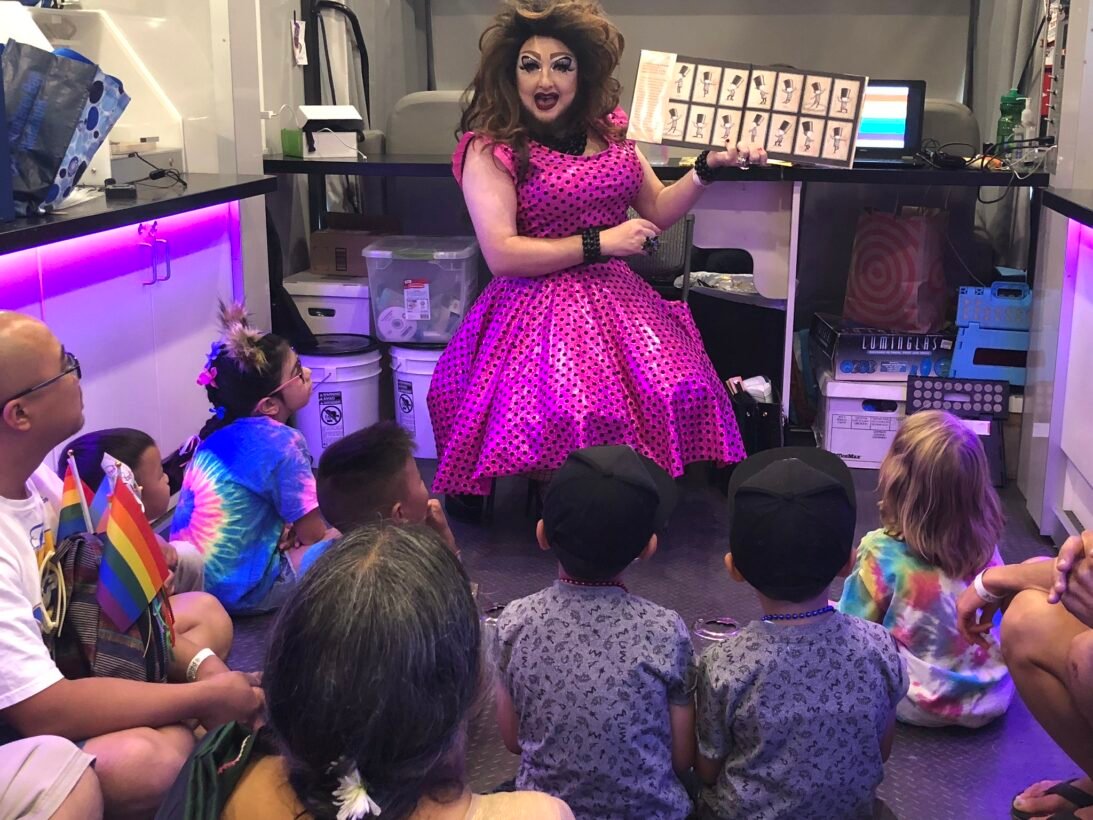
Creative Commons Image: San José Public Library MSS Drag Queen Storytime
As a kid I grew up in Renfrew, a small town of 8,000 about an hour’s drive west of Ottawa. We didn’t really take vacations. There were some trips to cottages of family friends. We didn’t travel beyond Ottawa for medical appointments or for school trips.
I didn’t make my first trip to Toronto until I was almost 18. Needless to say, in my sheltered, Catholic non-diverse and heteronormative upbringing, I didn’t know the word for what I was feeling. I really didn’t have a point of reference for what gay was.

My real first reference was Billy Crystal’s character Jody from the sitcom Soap that aired from 1977 until 1981. He seemed like a characture and not how I saw myself. His character didn’t really resonate with what I was feeling, even if I couldn’t put a name to it. Aside from Bugs Bunny, he was the first person I ever saw in drag.
When I tried to learn more, there wasn’t really anyone to turn to. I went to the Renfrew Public Library and didn’t find anything there. The Dewey Decimal System did not unlock the secret. It really would have helped to have some of the books that are being banned in some states in the US as a much yonger child.

In the early 80’s there was a movie called Making Love, with Harry Hamlin and Kate Jackson. It really was ground breaking for the time. I remember watching it when it came to TV, see a representation of what in my mind gay meant.
I can’t say I was really bullied in high school. I had friends, was in air cadets, worked at McDonald’s, was on the prefects council at school. Some of the other kids would call me homo, fag, the occaisionally accidentally on-purpose bump into me in the hallway. Nothing as horrific as some of the stories that you hear, including those that end with kids taking their own lives.
However, one young woman from my high school took it upon herself to out me to my parents. That was devistating to me as when they asked me about it, I really didn’t have an answer for them. I didn’t have the understanding or vocabulary to share what I was feeling. I just sat there in stunned silence and more than just a little shame.
What I would have given to be have raised in a time where there were books that would have shown me that what I was feeling was okay and that I had a good life ahead.

In the mid-to-late 1990s I started volunteering as a reporter and producer for the Rogers TV show Outlook in Vancouver. One of the stories I followed closely was that of the Surrey School Board not approving a request by primary school teacher James Chamberlain’s request to use three books that depicted same-sex parents in his classes.
The three books are Asha’s Mums, Belinda’s Bouquet and One Dad, Two Dads, Brown Dads, Blue Dads that depicted healthy same-sex parenting relationships. This tiggered complaints from religious parents who didn’t believe that they belonged in the classroom simply because they regard homosexuality as a sin.
As a reminder, this is a public school board, not a religous one. However, the Chair of the school board at the time was Heather Stilwell, one of the founders of the Christian Heritage Party. I raise this, not to criticize religion, but to show that even though we have separation of church and state the line often gets blurred for people of strong faith who seek public office.
For the remainder of the time I was on the show I covered the issue closely. I interviewed parents in Surrey who were supportive of the books being made available, covered protests and a resolution of support by the BC Teacher’s Federation. I also interviewed Murry Warren, a teacher from another school board who could use the books in his classroom.
Through a colleague at the station’s Victoria Bureau I was able to arrange interviews with the Education Minister and Attorney General and while they were sympathetic of the cause, they would say then could not intervene.
While I could not get an interview with the school district, I did receive a complaint about filming on school property, even though I was on public property and had a school in the background.
The case eventually made it’s way to the courts and worked it’s way all the way to the Supreme Court. Finally in 2002, the Supreme Court of Canada ruled against the board saying that the school board in Surrey went against provincial legislation that says the public school system is secular and non-sectarian.
Chief Justice Beverley McLachlin found that, “The board was not permitted to reject the books simply because certain parents found the relationships depicted in them controversial or objectionable.” Also adding, “Tolerance is always age appropriate”.
Sadly, even under new leadership, the schoolboard was undeterred. They reviewed the books again at the Supreme Court’s direction in 2003, rejectinging them again for among other things bad grammar.
Embed from Getty ImagesWhat’s really scary is seeing this play out again some 25 years later on a much larger scale. Five states have passed, including Florida have passed Don’t Say Gay or Trans laws. The Florida law bans classroom discussions about sexual orientation and gender identity in schools and prohibits teachers, school staff and students from being required to refer to people by pronouns that don’t correspond to the person’s sex assigned at birth.
It also has provisions that include vague parental notification requirements that could effectively “out” LGBT2S+-identifying students to their parents without their consent. Reseach has shown that LGBTQ2S+ are at a higher risk of suicide and many do not face acceptance when coming out. Research by the Trevor Project in 2021 found that more than 42 percent of LGBTQ2S+ youth seriously considered attempting suicide but those who learned about LGBTQ2S+ issues or people in classes at school had 23 percent lower odds of reporting a suicide attempt.
They are even using law enforcement tactics targeting teachers for discussing these topics and against librarians for allowing students to borrow books that a community member finds objectionable.
Their goal is clear erasing LGBTQ2S+ identity, history, and culture — as well as LGBTQ2S+ students themselves, all dressed up in the guise of parental rights.
Embed from Getty ImagesSome of these same US law makers have now turned their sights to drag events. They want to highly restrict where drag can be performed, even baning minors from observing drag performers, including at family-friendly library events for people and children of all ages, such as Drag Story Hour. Again, attempting to erase LGBTQ2S+ identity, history, and culture.
At it’s core, drag is performance art, but something even more. From the Stonewall riots of liberation to rasing money for people with HIV/AIDS and beyond drag queens have been there for the LGBTQ2S+ community. And it’s not like drag has not been a part of western culture, from To Wong Foo, Thanks for Everything! Julie Newmar to The Adventures of Priscilla, Queen of the Desert, Rocky Horror Picture Show to Hair Spray, Bugs Bunny to RuPaul’s Drag Race drag queens have enterained.
Their increasingly violent rhetoric, again with the false claim of protecting children, refering to drag queens as groomers, has resulted in protests by extreme hate groups and actual violence in the US. GLAAD found at least 141 incidents in 2022 of anti-LGBTQ protests and threats targeting specific drag events, and false rhetoric against performers was deployed in campaign ads for the 2022 midterm elections. In fact, there firebombing of a Tulsa donut shop that had hosted a drag event in October.
About 150 people are at the NAC to support a drag story time performance. Waving rainbow flags, dancing. pic.twitter.com/hq7I0WjklX
— Jacquie Miller (@JacquieAMiller) February 8, 2023
And if you think that can’t happen here in Canada, thing again. Inevitably and insidiously, the culture from southern neighbours makes its way across the border. Far-right religious protest groups and neo-nazis have actively protested outside events for children in Vancouver, Kelowna, Calgary, Sarnia, Peterborough, Brockville, Ottawa and Moncton.
In an interview with the Vancouver Sun, Drag Performer Conni Smudge said, “What I do at a nightclub at 11 p.m. at night is different from (what) I do at 10 a.m.” when children are present.”
In February of this year, a teen from my hometown Renfrew, was reportedly suspended from his high school after saying there are only two genders, in a classroom discussion about gender and transgender people. According to news reports he protested Drag Queen Story Time in Ottawa and had planned to do the same in Peterborough.
No one is born with this kind of hate in their hearts. I have to wonder what kinds of things he has been exposed to by Save Canada, a Christian youth-run organization. Might have turned out differently if the banned books from Surrey had been read to him in primary school? What if a drag queen had read them to him at the Renfrew Public Library? What kind of a person is he going to turn out to be?
What gives me hope is that in Canada, so far, there have been counter protests that far out numbered the protesters. Organizations like the Canadian Anti-Hate Network and PFLAG (Parents and Friends of Lesbian and Gays) have been working in communities to form bubbles of love to create a safe space for children to take part in Drag Story hours.
The past doesn’t have to become the future. So what can you do? It’s easy:
Read a banned book or take part a Drag Story Hour and see what it’s all about
Attend a drag show, start slow, maybe a brunch
Attend a PFLAG meeting in your community and become and ally
Participate events like pink shirt day, Day of Pink or International Day Against Homophobia, Biphobia and Transphobia
Call out discrimination when you see it
Write to elected officials